Flavor Variations of Tobacco Leaves from the Same Producing Region in Different Years
Many people, when first hearing that "tobacco also has vintage years," instinctively think of wine: the same vineyard, the same grape variety, and yet 2018 and 2021 can taste completely different. With tobacco, this phenomenon is even more stark — the soil skeleton, slope aspect, and variety can remain unchanged for years, yet as long as there is low temperature and excessive rain during the root extension period, heavy rain and insufficient sunlight during the vigorous growth period, or continuous overcast days during the maturation period preventing harvest, the chemical ledger and curing difficulty of the same producing region, same variety, and same stalk position will be rewritten, ultimately manifesting as completely different characteristics in the nasal cavity and oral cavity.
I truly started using "vintage" as a working language after several consecutive harvest seasons, when I sealed and evaluated middle and upper leaves from the same supply chain separately by year. What follows is not a producing region brochure, but: how climate enters the leaf, how difficult it was to cure/air-dry in that particular year, how it changed after six months to two years of aging, and finally how I personally used these materials.
I. Same Producing Region ≠ Same Face Every Year
The producing region provides the foundation: red soil or sandy soil, approximate elevation range, typical diurnal temperature variation, and the local curing methods (flue-curing barn, air-curing barn, sun-curing shed). The vintage year provides the seasonal configuration: whether heat was sufficient, whether water fell during critical windows, whether sunlight was stolen by continuous overcast, and whether pests and diseases forced early topping or delayed harvest.
Public research and regional experience roughly converge on the same causal chain:
| Growth Stage | How Climate "Writes Into the Leaf" | Common Sensory Outcomes (Summary) |
|---|---|---|
| Root Extension | Low temperature + low light → weak root system, unstable nutrient absorption later | Uneven growth, prone to "hunger" or "explosive growth," uneven maturity |
|---|---|---|
| Vigorous Growth | Rain-heat simultaneous vs drought stress | Heavy rain = large leaves but thin oil, loose structure; drought = increased nicotine, thick and hard leaves |
| Maturation | Sunshine and diurnal temperature range | Aroma precursor accumulation window (carotenoids, some terpenoids, etc.); continuous overcast = green off-flavors, increased false maturity |
| Curing Week | Whether barn temperature/humidity is controllable | Green off-flavor residue, color, burn quality, irritation — largely decided in this week |
The cigar community often says "microclimate + batch variation"; the cigarette raw material side tends to talk about "climate vintage + grade + stalk position." My experience is: Don't ask about the brand story first; first ask whether this season's maturation period had enough light and stable night temperatures, and whether the moisture curve was fully completed during curing.
In tobacco chemistry, the items most susceptible to interannual fluctuation are: reducing sugars and total sugars, nicotine and total nitrogen, polyphenols, starch residues, and the post-curing residual "green off-flavor-related" volatile compounds. Once the sugar-nicotine ratio shifts, the oral sweetness, strength, and irritation follow suit; high starch and protein residues make the off-flavors and "raw" sensation in the early aging period more stubborn.
II. The Production Line Used for Comparison (Scenario Description)
To tell the story clearly, I established a fixed "reproducible comparison protocol" rather than randomly sampling here and there:
The three vintage years below are the "cross-sections" I found most impressive and best suited for teaching. Vintage codes are Y-Dry, Y-Wet, Y-Balanced, corresponding to three climate configurations: drought with heat, rainy with low light, and relatively balanced; the specific calendar years can be replaced according to your own supply chain's actual years — logic matters more than labels.
III. Three Climate Vintage Years: Field → Curing → First Impression
1. Y-Dry: Drought During Vigorous Growth and Maturation, Sufficient Heat
Field. That season saw significantly less precipitation from vigorous growth through maturation. Farmers began worrying earlier than usual about "thick leaves with wrinkles and high nicotine." After topping, the upper leaves were thick and substantial; the middle leaves had acceptable oil content but felt rather "stiff" to the touch. The common field problem was not mold rot but localized premature senescence and leaf edge scorching, compressing the harvest window — three days late and the scorched tip ratio increased; three days early and maturity was insufficient.
Curing. There was a strong deceptive impression that it was "easy to cure" in the barn: the leaves dehydrated quickly, and yellowing seemed straightforward. The real trouble emerged at the end of yellowing through to color fixing: moisture dropped too rapidly, and green vein residue was easily concealed by the color. In one batch, because we raised the temperature too abruptly during color fixing, the color after coming out of the barn was acceptable, but the cold sniff revealed an irrepressible green off-flavor. That rework essentially cost us two days of barn energy consumption + an entire barn's worth of confidence.
First Impression (0–1 months).
Nasal: Dry woodiness, slight scorched edge, herbaceous sharp top note.
Oral/Smoke Structure: Strength on the higher side, tight sweetness, noticeable throat dryness.
My notes at the time roughly read: "Like drinking concentrated liquid without diluting it — it has substance, but it's not kind to people."
Personal Judgment. Y-Dry year material is suitable as a structural and strength layer, not suitable for carrying the banner of "delicate aromatic elegance" alone. When its proportion in a blend is high, the overall result tends to be "hard, dry, and harsh."
2. Y-Wet: Rain-Heat During Vigorous Growth, Low Light During Maturation
Field. It rained heavily during vigorous growth. The plants looked good, the leaves were large, and the farmers were initially in good spirits. The problem emerged during maturation: continuous overcast, reduced sunshine hours, the field maturity "looked yellow," but when you pinched the leaf veins and smelled the green aroma, you knew the false maturity ratio was not low. Disease pressure was also high, medication windows became tighter, and the disputes between farmers and purchasers dragged on from June to August.
Curing. This was the hardest season to flue-cure/air-dry among the three years. High moisture content, incomplete metabolism of cell wall materials and starch — prolonging the yellowing phase risked mold, while shortening it resulted in greenness. In one batch, because the stack was too dense after reordering, mold spots appeared at the edges, and the entire package was finally downgraded — the economic reckoning came faster than the technical discussion. On the air-curing side, if humidity control was unstable, green off-flavors would persist even after redrying.
First Impression.
Nasal: Grass, raw leaf, faint earthiness, blurred aroma profile.
Oral: Unstable strength — some leaves were thin and empty, others had localized irritation; after burning, the ash was dark and burn retention was mediocre.
Notes: "The classic penalty for big watery leaves — you got area, but you lost density."
Personal Judgment. Y-Wet year is not unusable, but you must acknowledge the inherently loose structure and insufficient aroma precursors. Aging can reduce irritation and off-flavors, but it can hardly turn "emptiness" into "richness." It is more suitable as a soft filler in blends, and the proportion should be restrained; if you expect it to become a high-end single material after two years of aging, I would advise you not to gamble.
3. Y-Balanced: Stable Root Extension, Rain During Vigorous Growth but Not Waterlogged, Sufficient Light and Heat During Maturation
Field. No dramatic disaster narrative. Normal root extension after transplanting, several soaking rains during vigorous growth that delivered the fertilizers, continuous fine weather during maturation, and the diurnal temperature range "brought out" the aroma precursors. Harvest could proceed by stalk position and maturity level in batches, rather than being rushed by the weather.
Curing. Not accident-free, but high tolerance for error. The yellowing—color fixing—stem drying curve could follow normal parameters, and after coming out of the barn, the orange-yellow ratio was high, and the oil content feel was uniform. In that season's spot-check samples, the appearance consistency of the middle leaves was the best in three years — during evaluation, we hardly needed to spend half an hour picking out the "defective leaves" first.
First Impression.
Nasal: Sweet wood, light nuttiness, faint honey note, low green off-flavor.
Oral: Medium strength, cohesive smoke, clean aftertaste.
Notes: "No need to explain defects first; you can talk directly about layers."
Personal Judgment. Y-Balanced year is usable as the primary aromatic layer and balance layer in a blend. The price is also typically higher — the market votes with its wallet, more accurately than any advertorial.
IV. After Aging: The Same Vintage Year "Grows" Along Different Trajectories
The conclusions repeatedly found in industry and research align with my own shelf observations: in natural aging/fermentation, the major chemical and sensory transitions mostly occur around the first year; the common quality window is approximately 18–24 months; after three years the aroma may begin to decline — older is not necessarily better. Polyphenols and other indicators often showphased decline before stabilizing; the reduction of off-flavors and irritation and the improvement of aroma quality are what people truly appreciate.
I brought the three vintage years onto the same timeline under identical storage conditions for comparison:
1. Approximately 6 Months
| Vintage | Direction of Change | How I Use It |
|---|---|---|
| Y-Dry | Harshness and dryness slightly reduced, but "hardness" remains; if green off-flavor remained after curing, only about one-third is reduced | Still too structural, too aggressive as standalone material |
|---|---|---|
| Y-Wet | Green off-flavor significantly softened, emptiness becomes clearer — less irritation, but more thin | Only usable as a soft base layer |
| Y-Balanced | Sweetness and coherence increase, layers begin to expand from "simple sweet wood" to light roasted notes | Already usable as a primary discussion subject |
Mistakes I've made in practice: Some people declare "aging complete" at 6 months. I tried increasing the blend proportion of Y-Dry at 6 months, and thefinished product turned dry in the middle section and bitter at thefinal third. The aging timeline cannot be copied from your neighbor's; it must be copied from the vintage's.
2. Approximately 12 Months
This is the first comprehensive evaluation node that I personally value most.
Storage detail: At the 12-month node, when we opened the packages, one batch had experienced a brief period where the warehouse RH exceeded 70% for over a week, resulting in marginal mold odor risk. Emergency repacking, humidity reduction, and isolation were required. Aging is not about throwing leaves into a dark room and praying; three days of humidityloss of control can destroy a window you've waited a year for.
3. Approximately 18–24 Months
One sentence summarizing my vintage-aging perspective:
**Balanced year: time is a friend.**
**Dry year: time is a whetstone — it can grind away the harshness, but not the bone.**
**Wet year: time is an eraser — it can erase green off-flavors, but it can easily erase substance along with them.**
V. How Climate Vintage Rewrites "Aging Potential"
Many people only ask "does this leaf smell good," not "does this leaf hold up well." Aging potentialroughly depends on:
1. Inherent Chemical Framework: Whether sugars, nitrogen, nicotine, polyphenols, and starch are within a reasonable range;extreme drought or floodeasily bias the axis.
2. Curing Completeness: Green veins, starch residues, uneven dehydration — these turn the early aging period into a "debt repayment" phase.
3. Physical Structure: Oil content, leaf thickness, and integrity affect the oxygen and moisture microenvironment; overly loose leaves are more prone to moisture absorption and aroma collapse.
4. Storage Discipline: Temperature, humidity, stack density, pest control, package inspection frequency. Poor discipline allows vintagedifferences to be drowned out by noise — you can't tell whether it's a climate problem or a warehouse problem.
Industry common sense also often suggests that aging should not be extended indefinitely for various grades; the aroma hits a turning point and then declines. My own practicalupper limit: ordinary flue-cured raw materials with about 2 years as the active window; special thick leaves and heavily fermented cigar materials area different matter, butalso require sensory reevaluation, not automaticappreciation by calendar.
VI. How I Use Materials by Vintage Character (Clear Opinion)
Below is my own usage, not an industry standard. You may disagree, but at least it's more honest than "mix all vintages into anonymous average":
1. Y-Balanced (Balanced Vintage): The central axis and aromatic layer of the blend. Stands on its own as a single material. The high price is justified by predictability.
2. Y-Dry (Dry Vintage): Used as structural framework and driving force. Start with a low proportion (e.g., first try 10%–20% by feel, then adjust according to product positioning), and allow at least 12 months before finalizing the formula.
3. Y-Wet (Wet Vintage): Used as soft filler and irritation buffer. Don't expect it to contribute complex middle andfinal third. Use it when it's ready at 12–18 months; obsessing over extended aging is not cost-effective.
4. Cross-Vintage Blending Principle: Use the balanced vintage to set the tone, the dry vintage to adjust structure, and the wet vintage to smooth things out — rather than churning three years' harvest into "anonymous homogeneous powder."
5. Records Matter More Than Legends: Write down the harvest season climate keywords + curing accidents + package opening date for each batch. Three years later, you will thank your past self.
If you are working with nasal sniffing, cold aroma teaching, or raw material cognition (rather than promoting tobacco consumption), vintage comparison is the best teaching tool: change the year from the same producing region, and your nose will go to school.
VII. Real Pitfall Checklist (More Useful Than Correct Statements)
1. Assuming "older leaves are always more premium." I aged Y-Wet for three years and tasted "clean emptiness" — polite, but boring.
2. Thinking curing accidents can be redeemed by aging. The green off-flavor left by overly hasty color fixing can be reduced in 12 months, but is very hard to fully eliminate; severely mold-spotted batches — aging just hides the problem in the warehouse smell.
3. Comparing only brand names and region names, not stalk positions. The vintage expression intensity of upper leaves and middle leaves from the same year differs; judging middle leaves' "stability" by upper leaves' "aggressiveness" distorts the discussion.
4. One warehouse RHloss of control event rewrites the vintage. The moldy and sour notes introduced by one week of high humidity will overwhelm the carefully anticipated aging benefits.
5. Drawing vintage conclusions from too few samples. Anomalies in a single package (barn malfunction, transport moisture damage) can be misinterpreted as "this year was bad." Use multiple packages, multiple points, multiple time nodes.
6. Moralizing climate differences. A dry year is not "more natural," nor is a wet year "less healthy" — they are just different agricultural and processing outcomes. Health risks come from tobacco use itself, not from the 2019 or 2021 label.
VIII. Putting "Vintage" Back Into Material Language
The flavor variation of tobacco leaves from the same producing region in different years is, at its core:
Climate configuration → field metabolism and maturity → curing completeness → initial chemistry and physical structure → evolution of aroma/irritation/thickness along the aging trajectory.
Y-Dry teaches you about structure and dryness, Y-Wet teaches you about greenness and emptiness, Y-Balanced teaches you about predictable harmony. Aging can rewrite irritation and off-flavors, can make some vintage years "drink well," but it cannot save leaves that never had substance to begin with, nor can it guarantee infinite improvement with age.
When I look at raw materials now, my first question is no longer "which producing region has the bigger name," but:
In which phase did the rain and sunlight fall this season? Was the curing (air-drying) curve fully completed? How long has it been in the warehouse, and has the warehouse betrayed you?
Answer these three questions clearly, and vintage is no longer a marketing term, but a material fact you can touch, smell, and write down in your notebook. As for whether to smoke or quit — that is a completely independent health decision — understanding tobacco vintage is about understanding materials, not about adding a halo to tobacco.
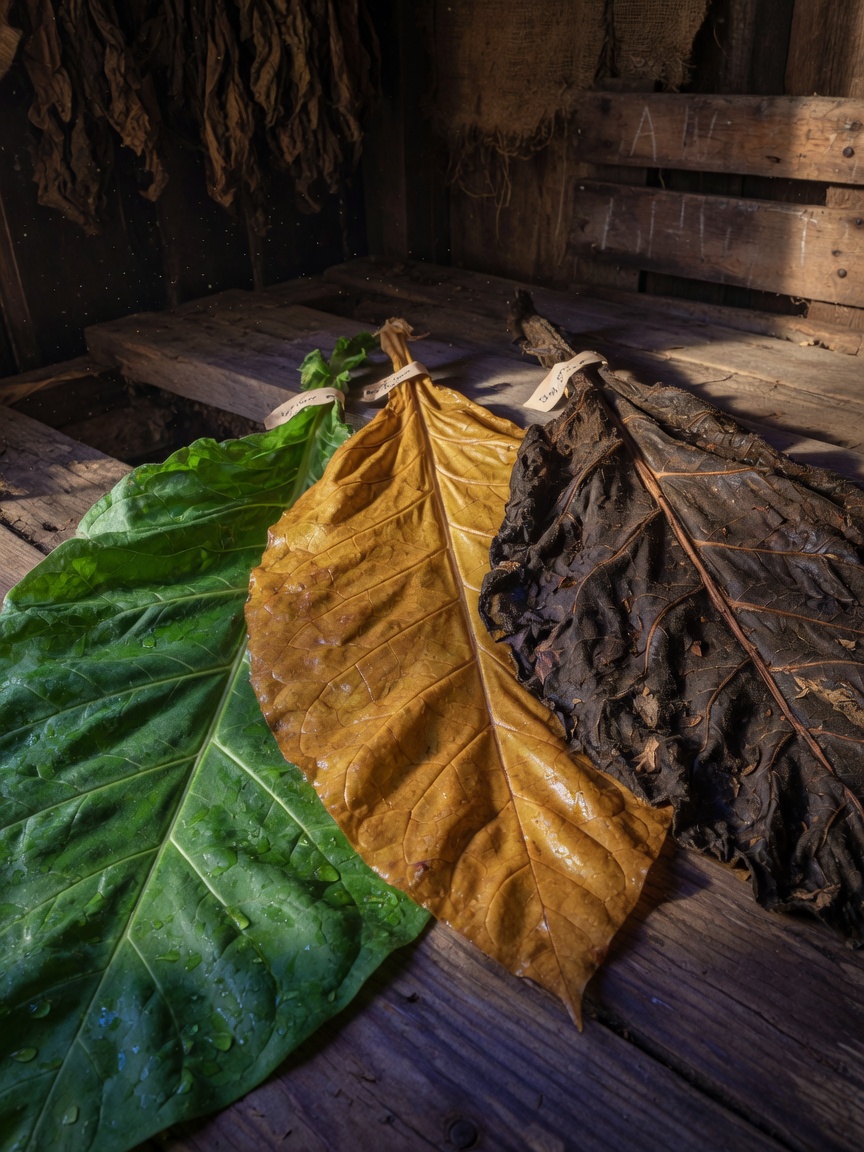
Dry Year vs Wet Year vs Balanced Year
Extreme vintages (Dry/Wet)
Distinct character but lopsided: dry year has structure but harshness, wet year has area but emptiness. Must be used with restraint, cannot carry alone.
Balanced vintage
Predictable, usable as主力: sweet wood, nuttiness, low green off-flavor, stands alone. The high price is justified by predictability.
※ Vintage codes Y-Dry/Y-Wet/Y-Balanced are typified summaries of climate configurations, not specific calendar years. Readers can replace them with their own supply chain's actual years.